



He Shou Wu for Hair Support: An Ancient TCM Legend Now Supported By Modern Hair Biology
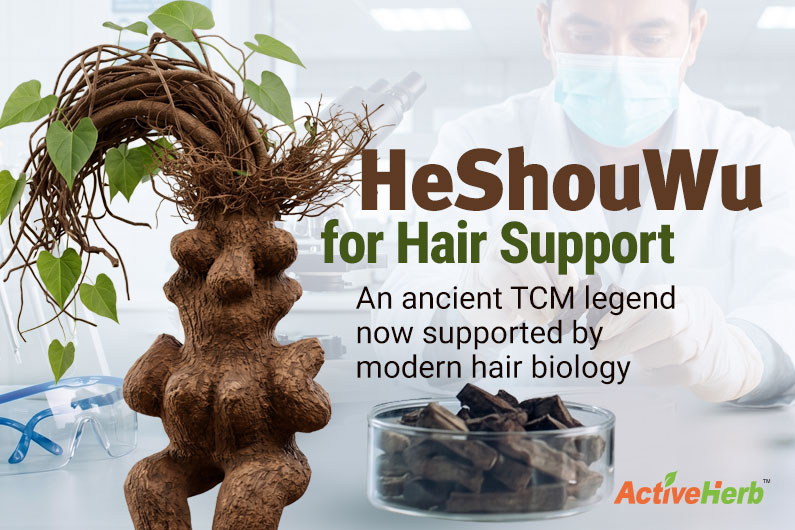
You start noticing a few extra strands of hair in the brush. Your scalp part widens or your hairline recedes. Or your roommate or spouse gets on your case about the hairs in the shower.
And these are only the visible changes. For many people, hair changes are psychological, affecting confidence and self-esteem. Passing by a mirror becomes an exercise in negotiation: maybe it’s the lighting, maybe it’s the angle, maybe it’s not as noticeable as it felt five seconds ago.
The legendary Mr. He Tian’er may not have had a modern bathroom mirror 1,000 years ago, but according to Chinese folklore, he knew something about aging before his time.
The Legend of He Shou Wu
It’s the TCM equivalent of Ponce de León and the Fountain of Youth.
The story begins during the Tang Dynasty (618–907 CE), in what later accounts describe as Nanhe County, in Hebei Province. A man named He Tian’er was 58 years old, weak, prematurely aged, unmarried, childless, fond of wine, and resigned to a life that had not exactly gone according to plan.
One night, after drinking too much fermented adult grape juice, he fell asleep outdoors and woke to the sight of two strange vines growing several feet apart, their tendrils repeatedly twisting together, separating, and joining again. Intrigued, he dug up the root and brought it home, but no one in the village could identify it. Eventually, someone suggested that if the plant seemed so unusually vigorous, perhaps He Tian’er should try it himself, since he could obviously use a botanical helping hand.
As the legend goes, he dried the root, ground it into powder, and began taking it with wine. Hey, one health modification at a time. Within days, he felt a stirring of vitality. Over the following weeks and months, the story says, his strength returned.
Mr. He’s old complaints improved, his face looked younger, and his gray hair darkened. He eventually married, had children late in life, and became so associated with the herb’s effects that the plant came to be known as He Shou Wu. Translation: “Mr. He’s black hair.”
The 58-year-old bachelor with gray hair and fast-fading vitality became the face of one of TCM’s most famous hair-support herbs. It’s about as unlikely a story as Chris Farley in his prime becoming the spokesperson for Equinox Fitness Clubs.
Why Hair Is More Than a Cosmetic Concern in TCM
In TCM, hair has never been viewed as separate from the rest of the body.
Long before modern dermatology described follicles, hormones, growth cycles, and scalp microcirculation, TCM connected healthy hair with deeper reserves of nourishment, vitality, Blood, Essence, and the Liver and Kidney systems.
Which brings us back to He Shou Wu.
Also known as Fo-ti, or Polygonum multiflorum, He Shou Wu is one of the most famous Chinese herbs associated with hair, healthy aging, and vitality.
Of course, legends are not clinical proof. But they do tell us that for more than 1,000 years, He Shou Wu has been closely associated with hair health in Chinese herbal tradition.
As we’ll explore in a little bit, modern research is beginning to explore why. But first, let’s examine the traditional uses of He Shou Wu in TCM from a patterning standpoint. (Not male pattern hair loss, but TCM diagnostic patterns.)
He Shou Wu in Traditional Chinese Medicine
In TCM, processed He Shou Wu, or Zhi He Shou Wu, tonifies (strengthens) the Liver and Kidney organ systems, while nourishing Blood, augmenting Jing (the body’s deep vital essence), darkening hair, and strengthening bones and tendons.
That may sound very different from modern hair-loss marketing, thus a translation is in order.
In TCM, the Liver stores Blood. Liver Blood nourishes the head, scalp, and hair. When Blood is abundant and moving properly, the hair is better supported from the inside out.
The Kidney stores Jing. As the source of deep constitutional reserve, Jing relates to aging, growth, reproduction, bones, marrow, and long-term vitality. Because hair changes often appear with age, stress, depletion, or constitutional weakness, TCM connects hair health to adequate Kidney Essence.
In plain English: TCM does not treat hair as a surface problem only. It sees hair as a visible reflection of deeper nourishment, dependent on multiple organ systems.
What Modern Hair Science Says
From a modern perspective, androgenetic alopecia, often called male pattern or female pattern hair loss, involves several biological factors. One of the most well-known is dihydrotestosterone, or DHT, a hormone that can gradually shrink hair follicles in genetically-susceptible people.
As follicles miniaturize, they may produce thinner, shorter, weaker hairs. Over time, the hair growth phase may become shorter, and visible thinning may become more noticeable.
Common modern treatments such as minoxidil and finasteride may help some people manage this process, but they are not ideal for everyone. Some people experience scalp irritation, unwanted hormonal effects, or simply prefer to explore a broader, more traditional support strategy.
This is why He Shou Wu has recently attracted renewed scientific attention.
A recent review published in the Journal of Holistic Integrative Pharmacy looked at Polygonum multiflorum and its possible relevance to androgenetic alopecia. The researchers reviewed historical herbal records, laboratory findings, animal research, and clinical reports. Their conclusion suggests that He Shou Wu may influence several biological pathways involved in hair follicle health.
That multi-target idea is very consistent with how TCM formulas are traditionally used.
A Multi-Pathway Herb for a Multi-Factor Problem
Hair health is not controlled by one switch. It involves hormones, follicle stem cells, blood flow, inflammation, cell survival, growth factors, nutritional status, stress, and time.
The new research review suggests that Polygonum multiflorum may support hair biology through several overlapping mechanisms.
First, some compounds in the herb have been studied for their influence on 5-alpha reductase, the enzyme involved in converting testosterone into DHT. Since DHT is one of the major drivers of follicle miniaturization in androgenetic alopecia, this is one reason researchers are paying attention.
Second, He Shou Wu appears to support follicle cell survival. In pattern hair loss, follicle cells may enter decline too early, shortening the active growth phase of the hair cycle. Research discussed in the review suggests that key compounds in Polygonum multiflorum may help regulate signals related to cell survival and programmed cell death.
Third, He Shou Wu may support regenerative signaling pathways, including pathways involved in helping dormant follicles reenter the growth phase. In modern terms, these include signals that help cells grow, communicate, repair, and maintain follicle activity.
Fourth, the herb may support scalp microcirculation. Healthy follicles need oxygen, nutrients, and proper blood flow. In TCM, this echoes the idea that hair depends on Liver Blood nourishment reaching the scalp.
In other words, modern science is beginning to describe in biochemical language what TCM has described in energetic and constitutional concepts for a very long time.
He Shou Wu Processing
In Chinese herbal medicine, raw He Shou Wu and processed He Shou Wu are not used the same way. The processed form, Zhi He Shou Wu, is the form traditionally used to nourish the Liver and Kidney, support Essence and Blood, and promote hair vitality.
Processing alters the traditional action of the herb and is also part of responsible use.
Like many potent herbs, He Shou Wu should be used properly. Excessive use, improper preparation, or poor-quality products have been associated with safety concerns, especially involving the liver in rare cases. This is one reason quality, preparation, dosage, and professional guidance matter.
Single Herb or Formula?
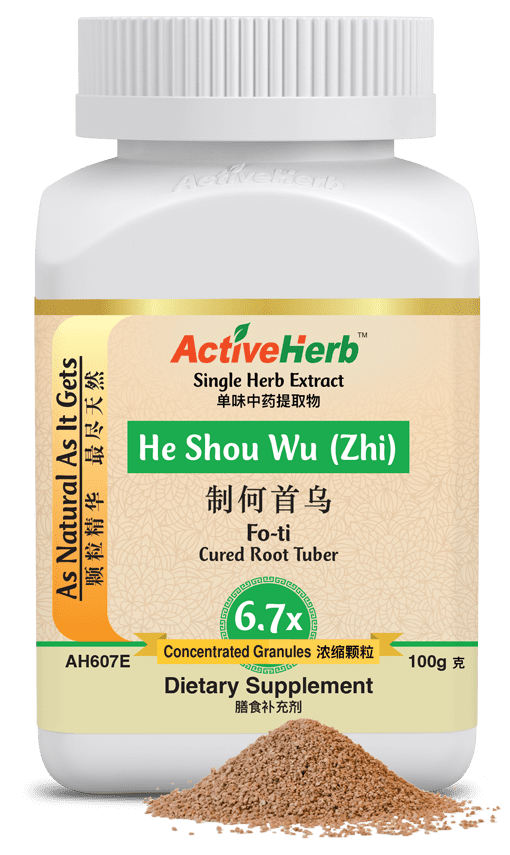
ActiveHerb offers both He Shou Wu as a single herb extract and Shou Wu Pian, also known as FotiHair™, a traditional formula featuring He Shou Wu as the main ingredient.
The single herb extract, He Shou Wu (Zhi), is a concentrated granule made from cured Fo-ti root tuber. In TCM terms, it tonifies the Liver and Kidney, nourishes Blood, augments Jing, darkens hair, and strengthens bones and tendons.
Shou Wu Pian takes a broader formula approach. In addition to He Shou Wu, it contains a blend of additional herbs to further support the Liver, Kidney, Blood, Essence, bones, tendons, and hair vitality. The formula reflects the traditional TCM strategy of nourishing the deeper roots of hair health rather than treating the scalp as an isolated surface.
Patience Is Part of the Process
Hair grows slowly. The hair cycle moves in phases. Even modern treatments for hair loss usually require several months before visible changes can be evaluated.
The same patience applies to TCM hair-support formulas.
He Shou Wu and Shou Wu Pian are not quick-fix products. They are tonic supports. In TCM, tonics work gradually by nourishing what has become depleted and supporting the body’s long-term reserves.
So don’t give up on the extract or formula after only taking it for a short duration.
People looking for hair support should think in terms of months, not days. Diet, stress, sleep, circulation, hormone balance, and constitutional health are also critical for a healthy hair follicle environment. Make TCM herbs for hair part of the plan, but consider a holistic approach.
TCM Hair Support Options
For those interested in traditional Chinese herbal support for hair vitality, ActiveHerb offers:
He Shou Wu (Zhi) Extract Granules
A concentrated single-herb extract of processed Fo-ti root tuber traditionally used to tonify the Liver and Kidney, nourish Blood, augment Jing, darken hair, and strengthen bones and tendons.
Shou Wu Pian / FotiHair™
A traditional multi-herb formula featuring He Shou Wu as the main ingredient, combined with additional herbs traditionally used to support Liver and Kidney nourishment, Essence, Blood, and healthy hair vitality.
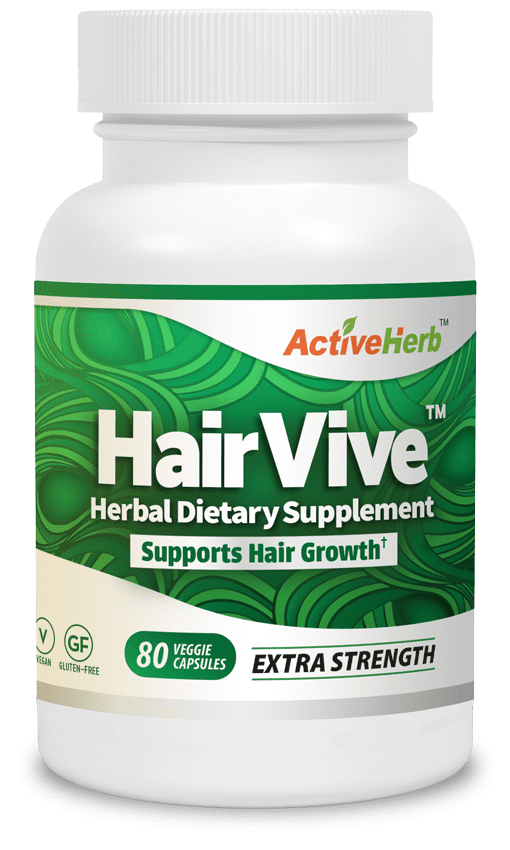
HairVive™
A modern capsule formula in ActiveHerb’s Modern Essentials line, designed to support healthy hair from within. Like FotiHair™, HairVive features He Shou Wu along with complementary Chinese herbs traditionally used to nourish the Liver and Kidney, support Blood and Essence, and promote fuller, healthier-looking hair over time.
The differences:
- He Shou Wu Extract Granules: Single-herb flexibility, add to hot water for instant herbal hair-health tea!
- FotiHair™: A more traditional tablet formula. (6 tablets per serving)
- HairVive™: A convenient modern capsule approach to TCM hair support. (2 capsules per serving)
As always, use Chinese herbs as directed, and consult a qualified herbal practitioner or physician if you are pregnant, nursing, taking medications, managing a medical condition, or unsure which product is right for you.
Support hair vitality the traditional TCM way with He Shou Wu (Zhi) Extract Granules or Shou Wu Pian / FotiHair™, both rooted in centuries of Chinese herbal wisdom and made with ActiveHerb’s commitment to quality, potency, and transparency.
Reference:
Han B, Xiao M, Xin T, Hu H, Liu Q, Xu B. Research progress on the application of Pleuropterus multiflorus in the treatment of androgenetic alopecia. Journal of Holistic Integrative Pharmacy. December 18, 2025.
Related Posts

About The Author
