



Ear Seeding in TCM: How Tennis’ Greatest Player Shines a Spotlight on “Aural Acupuncture”
Did you enjoy watching one of the world’s greatest sporting spectacles that recently concluded?
No, not the FIFA World Cup, although the first 48-team edition of soccer’s global tournament delivered plenty of exciting moments. Instead, let’s revisit Wimbledon, where tennis legend Novak Djokovic fell short of capturing his record-extending 25th Grand Slam singles title after losing to #1-ranked Jannik Sinner in the semifinals.
At age 39, otherwise known as ancient by elite-tennis standards, Djokovic continues to compete remarkably well against players nearly half his age. What does his impressive longevity have to do with the ActiveHerb Traditional Chinese Medicine blog?
Everything with his ears.
If you watched Wimbledon closely, you may have noticed that Djokovic’s aural appendages were decorated with several tiny beige dots.
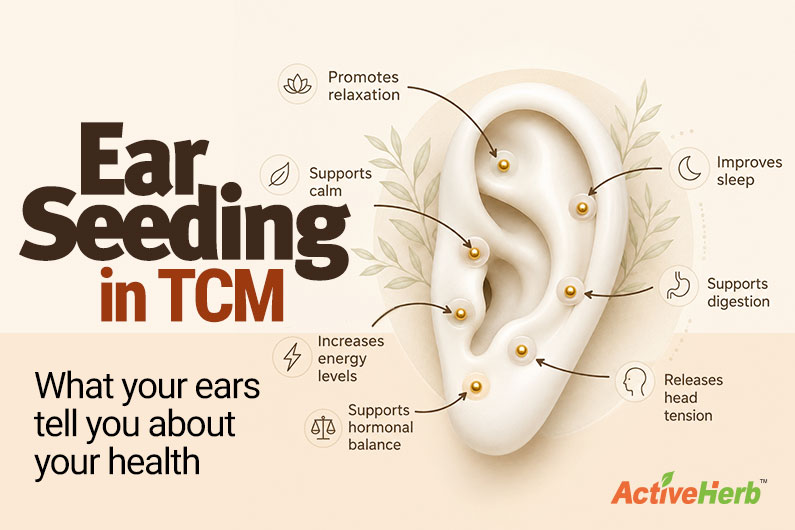
No, Djokovic was not experiencing a midlife crisis and experimenting with an unusual new piercing arrangement. Instead, the dots were ear seeds, a needle-free form of auricular acupressure that has recently become one of the more visible TCM-inspired wellness trends.
What Is Ear Seeding?
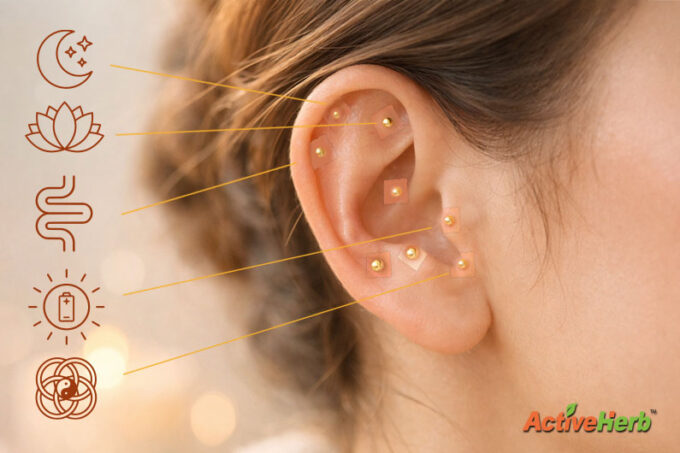
Ear seeding involves placing tiny seeds, pellets, beads, or metal studs over selected points on the outer ear. A small piece of adhesive tape keeps each seed in place.
The wearer periodically presses the seeds to stimulate those points, usually several times per day. Depending on the practitioner’s instructions and the condition of the skin, the seeds may remain in place for a few days before being removed or replaced.
Traditional ear seeds were often made from the seeds of Vaccaria, known in Chinese herbal medicine as Wang Bu Liu Xing. Today, practitioners also use ceramic beads, stainless-steel pellets, magnets, plastic beads, or decorative gold-colored studs.
Unlike auricular acupuncture, ear seeding does not puncture the skin. That helps explain its growing popularity among people who are curious about acupressure but don’t love getting jabbed.
How Does the Ear Represent the Entire Body?
The basic premise of auricular therapy is that the external ear contains points that correspond to different areas and functions of the body.
You can think of the ear as a small control panel. A practitioner selects certain buttons on that panel based on the individual’s needs, then applies gentle pressure to encourage a response elsewhere in the system.
In many modern auricular maps, the body is pictured as an upside-down fetus curled within the ear. The head corresponds roughly to the earlobe, while the spine and limbs extend along the curved cartilage.
The history, however, is more complicated than many TikTok explanations suggest.
Chinese medical writings document the relationship between the ears, meridians, and internal health going back centuries. Various forms of ear stimulation have also been used for thousands of years. But the detailed inverted-fetus map associated with modern auriculotherapy was largely developed by French physician Paul Nogier during the 1950s and was later studied and incorporated into Chinese auricular medicine.
Ear seeding is therefore best understood as a practice with ancient roots and a modern, standardized body map.
Ear Seeding Through a TCM Lens
In TCM, the ears are traditionally connected with the Kidney system.
That does not mean the kidneys merely control hearing in the Western anatomical sense. The TCM Kidney system is also associated with Jing, or Essence, the foundational reserve linked with growth, development, reproduction, aging, bones, and long-term vitality.
This may help explain why the appearance and function of the ears traditionally received attention when evaluating a person’s constitutional strength.
The ears are also connected with the body’s broader network of meridians. Stimulating a point on the ear is thought to communicate with this network, helping regulate the movement of Qi and Blood and encouraging the body to return toward balance.
The selected points vary. Some are chosen because they correspond with a particular area of the body. Others are used more broadly to support calmness, regulation, or the body’s response to discomfort.
One frequently used point is Shen Men, sometimes translated as “Spirit Gate.” It is commonly included in auricular protocols intended to calm the mind and complement other points being treated.
But there is no single “athletic performance point,” “sleep point,” or “weight-loss point” that works identically for everyone. A trained practitioner normally considers the person’s overall pattern rather than simply decorating the ear according to a generic chart found online.
Why Do Athletes Use Ear Seeds?
Djokovic has long taken an expansive approach to health and athletic longevity. His routines have reportedly included breathwork, dietary restrictions, heat and cold exposure, meditation, and other recovery practices.
Ear seeding fits neatly within that approach.
For an elite athlete, its appeal centers around ease of use, including:
- It does not involve needles during daily use.
- The seeds can remain in place between treatments.
- The wearer can stimulate the points independently.
- There is little interruption to training or travel.
- The method may be combined with other recovery strategies.
Ear seeding should not be viewed as something that magically transforms an athlete’s serve or restores an injured joint overnight. It is more like keeping a gentle finger on a therapeutic doorbell: the seed provides repeated, localized stimulation whenever it is pressed.
For Djokovic, that may have made it an attractive complementary tool during a physically and mentally demanding tournament.
Does Ear Seeding Work?
The fairest answer is that the research is promising in certain areas, but it is not conclusive for every claim circulating online.
Pain is among the better-studied uses.
A 2021 systematic review examined 46 clinical studies of auricular point acupressure for acute and chronic pain. Most of the included studies reported positive findings, particularly when auricular acupressure was combined with other interventions. The researchers also found wide variation in the points selected, treatment duration, seed-replacement schedules, pressing frequency, and intensity.
Ultimately, because of the variables, results depend on:
- Which points are selected
- Whether the underlying problem is acute or chronic
- How often the seeds are pressed
- How firmly they are pressed
- How long the treatment continues
- Whether ear seeding is used alone or alongside other care
Earlier research reviews have also found evidence supporting auricular therapies for pain while emphasizing the need for larger, better-designed randomized trials.
There has also been research into auricular therapy for stress, anxiety, sleep, postoperative recovery, and other concerns. However, the strength and consistency of the evidence vary. Ear seeds are best treated as a complementary practice, not a stand-alone replacement for appropriate medical evaluation, physical therapy, medication, sleep, nutrition, rehabilitation or best-in-class traditional Chinese herbal formulas.
Obviously, Djokovic’s ear seeds were one small part of a much larger performance system.
Are Ear Seeds Safe?
Because ear seeds do not penetrate the skin, they are generally less invasive than acupuncture needles. Nevertheless, “needle-free” does not mean risk-free.
Possible issues include:
- Skin irritation from the adhesive
- Tenderness or soreness
- Redness or itching
- Sensitivity to metal or latex-containing materials
- Infection if damaged skin is not kept clean
- Seeds becoming embedded when worn for too long (a permanent earring!)
- Incorrect point selection or excessive pressure
For the safest and most individualized experience, work with a licensed acupuncturist or another practitioner who has been properly trained in auricular therapy.
Ancient Practice, Modern Accessory
Part of ear seeding’s viral appeal is visual.
Decorative gold or silver seeds can resemble a tiny constellation of piercings. They are subtle enough to wear in public but unusual enough to invite questions, especially when those ears belong to the G.O.A.T.T. (Greatest Of All Time Tennis) Player.
Ear seeding represents the TCM principle that small, repeated inputs and effort may encourage broader changes in the body. Once the seeds are properly positioned, the wearer can stimulate them while working, traveling, watching television, or waiting to return serve on Centre Court.
Perhaps that’s why an old therapeutic concept has found such a comfortable home in modern wellness culture.
Support Your Own Active Lifestyle
Most of us are not trying to win a Grand Slam title. But recreational tennis, pickleball, running, hiking, surfing, strength training, and ordinary aging can still ask a great deal of the joints.
In TCM, joint stiffness and discomfort may be interpreted through patterns involving obstructed Qi and Blood, Wind, Dampness, and an underlying weakness of the Kidney system.
JointsJoy™ (Du Huo Ji Sheng Pian) is a traditional Chinese herbal formula used to expel Wind and Dampness, nourish Blood, soothe the sinews, and support healthy joint function.
This makes it a logical herbal companion for active adults seeking traditional support for comfortable movement. Like ear seeding, however, JointsJoy should not be positioned as a substitute for MRI scans, rehab, training, or professional treatment of an injury.
The greater lesson from Djokovic’s dotted ears is not that one tiny wellness technique holds the secret to extraordinary longevity. It is that staying active over time usually requires a layered approach.
Train intelligently. Recover deliberately. Nourish the body. Listen when it sends warning signals. And remain open to the possibility that even something as small as a seed on the ear may have a place within the larger picture, which includes the purest and most potent traditional Chinese medicines on the market.
References:
Hou PW, Hsu HC, Lin YW, Tang NY, Cheng CY, Hsieh CL. The History, Mechanism, and Clinical Application of Auricular Therapy in Traditional Chinese Medicine. Evid Based Complement Alternat Med. 2015;2015:495684.
Liu M, Tong Y, Chai L, Chen S, Xue Z, Chen Y, Li X. Effects of Auricular Point Acupressure on Pain Relief: A Systematic Review. Pain Manag Nurs. 2021 Jun;22(3):268-280.
Nogier R. History of Auriculotherapy: Additional Information and New Developments. Med Acupunct. 2021 Dec 1;33(6):410-419.
Son CG. Clinical application of single acupoint (HT7). Integr Med Res. 2019 Dec;8(4):227-228.
Related Posts



About The Author
