



Bai Shao in TCM: White Peony Root for Tension, Cramps and Balance
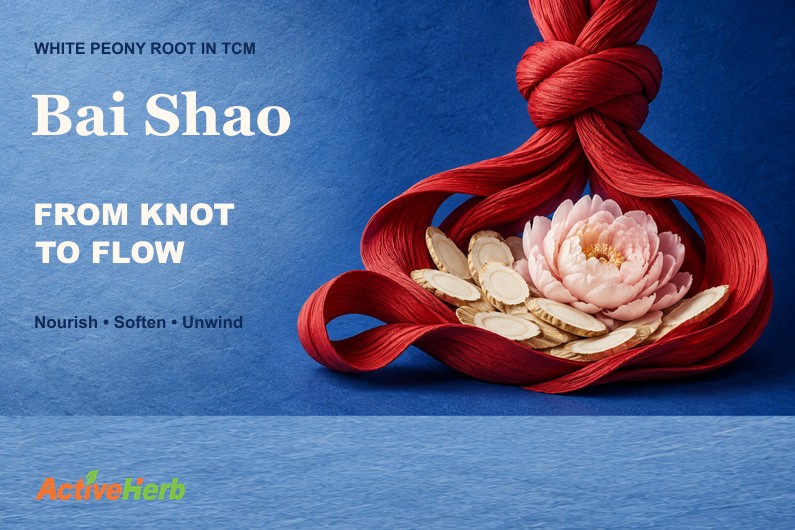
Ever feel like your body is holding tension in all the wrong places? Tight shoulders and neck, stubborn cramps, and a jaw that won’t unclench … In TCM, that kind of “wound too tight” feeling can overlap with Blood and Liver imbalances. Bai Shao, or White Peony Root, is one of the classic herbs used when the body feels both depleted and unable to let go and relax.
A peony may conjure visions of oversized pink blossoms arranged in an expensive vase. But truth be told, Bai Shao is just slightly less Instagrammable. Here’s what the flower looks like and what it looks like once the root has been processed into a bulk herb:
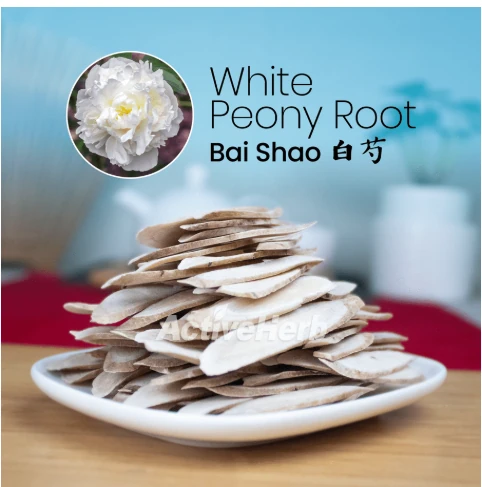
The medicinal part is the peeled, dried root of Paeonia lactiflora (Chinese peony), a staple of Chinese herbal medicine for centuries.
What Does Bai Shao Do in TCM?
Bai Shao primarily works with two TCM systems: the Liver and Blood.
If you’ve read our article on Blood deficiency versus Blood stagnation, you know that TCM Blood is about more than what shows up on a CBC (complete blood count) reading. Blood also nourishes tissues, supports menstruation and helps keep the body balanced, and the emotions grounded.
In addition to nourishing Blood, Bai Shao “softens” or harmonizes the Liver.
To explain this function, think of the Liver as part traffic controller, part road-maintenance crew. Its job is to keep Qi moving smoothly. When traffic backs up or the roads get rough, everything feels too tightly wound: muscles tense, emotions simmer and menstrual discomfort may become more noticeable.
Bai Shao doesn’t come through like a bulldozer clearing the road. It works more like easing congestion and helping traffic flow normally again.
How May Bai Shao Help Cramps and Tension?
Here’s where the Blood-and-Liver connection becomes more tangible.
In TCM, the Liver helps govern the sinews (tendons, ligaments and muscular system involved in movement). Blood nourishes those tissues. When that nourishment is insufficient, muscles may be more prone to tightness, twitching or cramping. That’s why Bai Shao often appears in formulas designed for patterns involving both tension and deficiency.
(In TCM, a cramp isn’t regarded only as “a muscle problem.” The practitioner may also ask whether the tissue is adequately nourished and whether Qi is flowing freely.)
How Bai Shao Helps the Body Stay Cool by Preserving Yin
Yang is the body’s furnace, fueling warmth, activity and movement. Yin acts like a coolant, lubricant and reserve tank in one; the absence of dis-ease requires a balance of both.
One way Bai Shao protects the reserve of Yin is by helping the body hold onto its fluids.
Bai Shao’s sour nature is traditionally considered astringent, meaning it helps keep valuable fluids from escaping too freely. That’s why the herb also appears in TCM discussions of spontaneous sweating and other patterns in which the body isn’t holding onto Yin as effectively as it should.
Why Is Bai Shao So Common in Women’s Formulas?
TCM closely links menstruation with Blood and the smooth flow of Liver Qi. So it’s no surprise that Bai Shao is featured in several TCM women’s formulas.
One famous example is Xiao Yao San (EaseTonic in ActiveHerb’s Modern Essentials line) a centuries-old formula used when stress, Liver Qi stagnation and Blood deficiency overlap. In very loose, decidedly non-TCM terms, the idea is this: sometimes the body doesn’t need to be pushed harder. It just needs enough support to finally unclench and unwind.
What Does Modern Research Say About White Peony Root?
Much of the modern research has focused on paeoniflorin, one of the major compounds found in Bai Shao.
Paeoniflorin has caught researchers’ attention for a surprisingly wide range of possible effects, from inflammation and immune function to the brain and heart. Researchers have also studied extracts known as total glucosides of peony. (These findings are intriguing, but much of the work remains preclinical.)
What’s interesting is the overlap: modern researchers are examining inflammation, nerve signaling and muscle function in an herb long associated with tension, discomfort and regulation.
How To Try Bai Shao
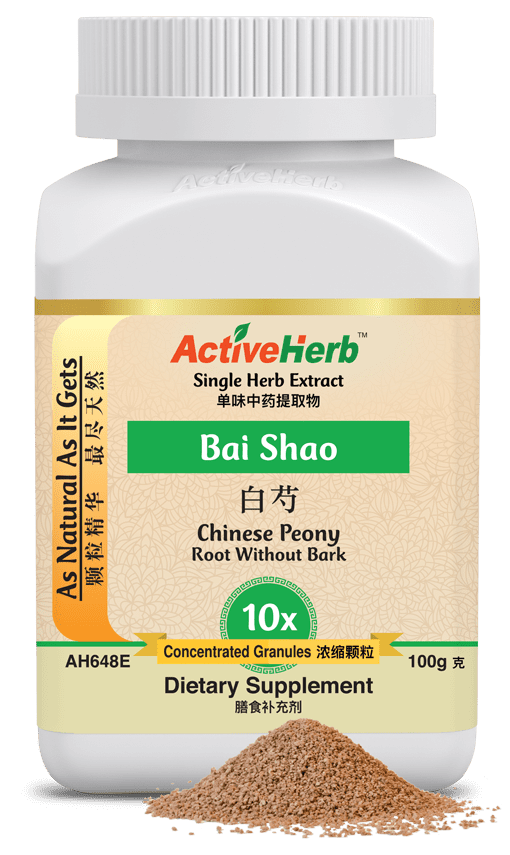
ActiveHerb offers 10x concentrated Bai Shao extract granules that mix easily with warm or hot water for instant herbal tea.
Traditional bulk White Peony Root is also available.
ActiveHerb also offers roasted Bai Shao (Chao) extract, a gentler traditional preparation. The roasted version may be a better fit when digestive sensitivity or Spleen weakness is part of the TCM pattern.
Bai Shao also appears in several classic and specialty formulas, including:
As mentioned, EaseTonic™ supports mood, Liver Qi movement and Blood. Available in capsules, tablets and tea pills.
GyneAssure™: Choose between Gui Zhi Fu Ling Pian (tablet form) or Wan (teapills). This women’s formula supports healthy circulation and menstrual balance.
ShoulderEZ™ (Jian Zhou Tong Pian): This signature tablet formula pairs Bai Shao with circulation- and channel-supporting herbs to support shoulder mobility and ease discomfort.
Related Posts

About The Author
