


TCM Herbs in the Bible: When Scripture Meets the Materia Medica
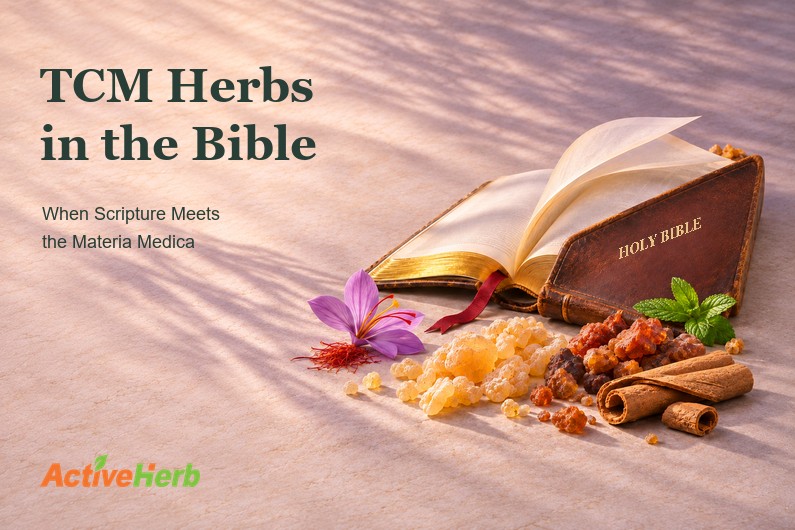
Gold, frankincense and myrrh.
Even people who haven’t cracked open a Bible lately probably remember the gifts presented to Jesus by the Magi.
But here’s something your Sunday school teacher probably never mentioned: two of those famous gifts would eventually become part of the Chinese materia medica, a written herbal tradition dating back roughly 2,000 years that catalogs medicinal substances and their uses.
And frankincense and myrrh aren’t alone.
At least five botanicals mentioned in the Bible have clear counterparts in Chinese herbal medicine, with several other possible overlaps depending on how ancient plant names are interpreted.
Even more surprising, one short passage of the Bible reads almost like somebody raided an ancient herbal dispensary.
The Original Gold, Frankincense and Myrrh
In Matthew 2:11, the Magi arrive bearing three gifts: gold, frankincense and myrrh.
Gold needs little explanation.
The other two? They’re tree resins, both of which became important Chinese medicinal substances.

Frankincense is Ru Xiang. In TCM, it invigorates the Blood, promoting the movement of Qi and addressing pain and swelling associated with stagnation.
Myrrh is Mo Yao, a potent Blood mover that disperses Blood Stasis.
In fact, Ru Xiang and Mo Yao are frequently paired in Chinese herbal formulas. For instance, the two famous Biblical herbs provide sciatic nerve support in the formula, Zuo Gu Shen Jing Tong – available as SciaticClear™.
Frankincense and myrrh didn’t disappear after the Nativity story. Both became prized medicines, fragrances and ritual substances traded across the ancient world.
What the Heck Is Myrrh, Anyway? TCM Has an Answer
Frankincense at least sounds vaguely familiar. As for myrrh, Monty Python fans may recognize the question. In the film Monty Python’s Life of Brian, the Three Wise Men accidentally present their gifts to the wrong baby, Brian Cohen. Brian’s mother is delighted by the gold and frankincense, but completely stumped by the third gift, asking: “What is myrrh, anyway?”

To answer the question posed by the false messiah’s mother and countless others, myrrh is a fragrant resin obtained from trees and shrubs of the Commiphora genus. When the bark is cut, resin seeps out and eventually hardens. Intensely aromatic, myrrh resin was prized for incense, perfumes, ritual use and medicine, and its Biblical resumé extends well beyond the Nativity.
Myrrh appears in the sacred anointing oil described in Exodus 30:23, and much later in the story, John 19:39 describes Nicodemus bringing a mixture of myrrh and aloes for Jesus’ burial.
In Chinese herbal medicine, Mo Yao, of course, took on an entirely different role. It became associated with traumatic injuries, pain, swelling and Blood Stasis, the kind of herb traditionally considered when Blood isn’t circulating freely through an injured area.
Cinnamon’s Holy Biblical History
In Exodus 30:23-25, cinnamon was one of the ingredients used to prepare sacred anointing oil.
Chinese medicine also developed a serious appreciation for cinnamon, particularly Cinnamomum cassia.
The bark is known as Rou Gui. It is strongly warming and is traditionally used to dispel Cold, support Yang and encourage circulation. The twig, Gui Zhi, became a separate medicinal substance with its own applications.
So the cinnamon sitting next to your nutmeg has a considerably more interesting family history than its role in pumpkin-spice season would suggest.
Cinnamon buns apparently came much later.
->->-> Learn more by reading our post, Cinnamon Uses In TCM: Beyond The Sweet & Spicy.
The Song of Songs Reads Like An Herb Garden
The Song of Songs, also called the Song of Solomon, is one of the Bible’s more unusual books. Instead of the usual narratives about laws, battles or prophecy, the Song of Songs is essentially a collection of lyrical poetry filled with sensual imagery, gardens, perfumes, spices and, yes, herbs that are commonly used in TCM.
In a single verse (Song of Songs 4:14), it name-checks nard, saffron, calamus, cinnamon, frankincense, myrrh and others.
Saffron, known in TCM as Xi Hong Hua, is not to be confused with safflower, or Hong Hua. They come from entirely different plants, although both invigorate Blood and break up Blood Stasis.
Spikenard: The Biblical Herb Worth a Small Fortune
If the word “nard” immediately conjures up Ed Helms as Andy “The Nard Dog” Bernard from the U.S. version of The Office, you’re excused.
Long before Dunder Mifflin became America’s most famous fictional paper company, nard had already built quite a reputation of its own, making an appearance in the New Testament.
In Mark 14:3, a woman pours an alabaster jar of extremely expensive pure nard over Jesus. The value of the perfume becomes part of the story precisely because this wasn’t the ancient equivalent of Axe body spray; it was more like pouring out a bottle of Chanel No. 5.
Nard comes from Nardostachys jatamansi, a Himalayan plant whose roots and rhizomes (horizontally-growing root-like stems) are intensely aromatic.
The same plant is known in Chinese herbal medicine as Gan Song, which regulates Qi and is used when stagnation contributes to discomfort in the digestive system.
More TCM Herbs in the Bible
Calamus (Shi Chang Pu) appears alongside cinnamon in Exodus and Song of Songs. A species of Acorus, Calamus is a strong Phlegm vaporizer!
The Bible mentions at least one other herb that remains commonplace in Chinese herbal medicine: mint.
In Matthew 23:23, Jesus criticizes the scribes and Pharisees for meticulously tithing even tiny amounts of mint, dill and cumin while neglecting “the weightier matters” of justice, mercy and faithfulness.
At roughly the same point in history, half a world away, mint was also being used medicinally in China. Known in TCM as Bo He — Bo He extract granules, perfect for making instant peppermint tea — mint became a common herb for dispersing Wind-Heat, clearing the head and eyes, soothing the throat and helping move constrained Liver Qi. (See mint’s traditional TCM uses in this research review.)
Different traditions, half a world apart, were valuing many of the same plants at roughly the same time, connected by trade routes and a shared belief in the power of the natural world.
Related Posts



About The Author
