



What Your Feet Say About Your Health in Traditional Chinese Medicine

Traditional Chinese Medicine (TCM) finds health clues in unexpected places. Your tongue, for example, can reveal patterns through its color, shape, moisture, and coating. Your fingernails may offer clues about Blood, Jing, and circulation. And as we recently explored, even the humble ear has been mapped and stimulated as a microsystem representing the body.
So naturally, TCM also has a few things to say about your feet.
Before you pull off your socks and begin conducting a forensic investigation of your soles, however, there’s an important distinction to make.
You’ve probably heard of reflexology, the practice of applying pressure to specific parts of the feet that are believed to correspond with other areas of the body.
And reflexology certainly sounds very TCM.
Qi? Check.
Pressure points? Check.
Feet connected energetically to internal organs? Also check.
But the story is a little more complicated.
Is Reflexology a Form of Traditional Chinese Medicine?
Sort of, but not exactly.
TCM has used massage, acupressure, acupuncture, and stimulation of points on the feet for centuries. Six of the body’s major meridians—the Liver, Spleen, Kidney, Stomach, Gallbladder, and Bladder channels—either begin or end in the feet. In TCM theory, these channels help explain why stimulating points far from the torso may influence functions associated with internal organ systems.
But the colorful foot reflexology charts you’ve probably seen at spas (the ones that make the sole of your foot look like a miniature anatomical map) are largely a modern development, not an ancient Chinese diagnostic chart.
The modern story begins in the early 1900s with American ear, nose, and throat physician Dr. William Fitzgerald.
Fitzgerald developed what he called zone therapy, dividing the body into 10 longitudinal zones running from the head to the fingers and toes. He proposed that applying pressure within one zone could affect other parts of that same zone.
A few decades later, physiotherapist Eunice Ingham, aka “The Foot Lady,” placed much greater emphasis on the feet and developed detailed maps associating regions of the feet with organs and body parts. Her work helped turn zone therapy into the modern practice now commonly called reflexology.
So while modern reflexology was influenced by older healing traditions, including TCM, it shouldn’t simply be described as an ancient TCM practice handed down unchanged for thousands of years.
The Foot as a Map of the Body
In modern reflexology, the body is essentially superimposed onto the feet. Imagine a tiny person curled up inside each foot. The toes represent the uppermost part of the body. The ball of the foot roughly corresponds with the chest, while the arch represents much of the abdominal region. As for the heel, it corresponds more closely with the pelvis and lower body.
Therein lies a simplified reflexology map….
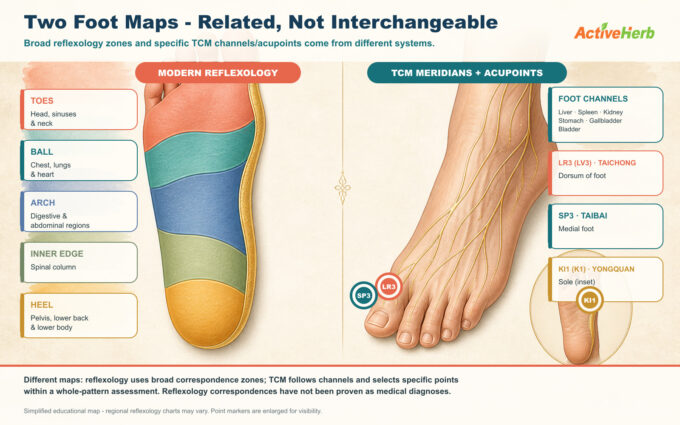
Toes: Head, Brain, Sinuses, and Neck
The toes occupy the “top floor” of the reflexology map.
The big toe is generally associated with the head and brain, while other toe regions may be mapped to the sinuses, eyes, ears, and neck.
That might sound familiar if you read our recent post about ear seeding. Both practices use the concept of a microsystem; one small part of the body serving as a miniature representation of the whole.
Ball of the Foot: Chest, Lungs, and Heart
Move downward to the padded area beneath the toes and you enter the metaphorical chest cavity.
Reflexology charts typically associate this region with the lungs and chest, with portions of the left foot also corresponding with the heart.
Picture placing a tiny human torso over your foot.
The ball of the foot is approximately where the rib cage would land.
Upper Arch: Stomach, Liver, Pancreas, and Digestive Organs
Depending on the reflexology system being used, areas of the upper and middle arch may correspond with the:
- Stomach
- Liver
- Gallbladder
- Pancreas
- Kidneys
- Adrenal glands
- Small intestine
The liver (of Western anatomy) is generally mapped more prominently on the right foot, reflecting its anatomical position, while stomach-related areas appear more prominently on the left.
Inner Edge of the Foot: Spine
Run your finger down the inside edge of the foot from the big toe toward the heel.
Reflexologists commonly associate this line with the spinal column.
The upper inner edge corresponds with the cervical spine, followed by the thoracic and lumbar regions as you move toward the heel.
Lower Arch and Heel: Intestines, Pelvis, and Lower Back
As you approach the heel, you’re heading south on the reflexology body map.
The lower arch and heel are commonly associated with areas involving the:
- Lower intestines
- Bladder
- Pelvic region
- Reproductive organs
- Lower back
- Sciatic region
The National Center for Complementary and Integrative Health notes that reflexologists believe these points correspond to other areas of the body, but that the proposed healing connections have not been established scientifically.
How TCM Reads the Feet
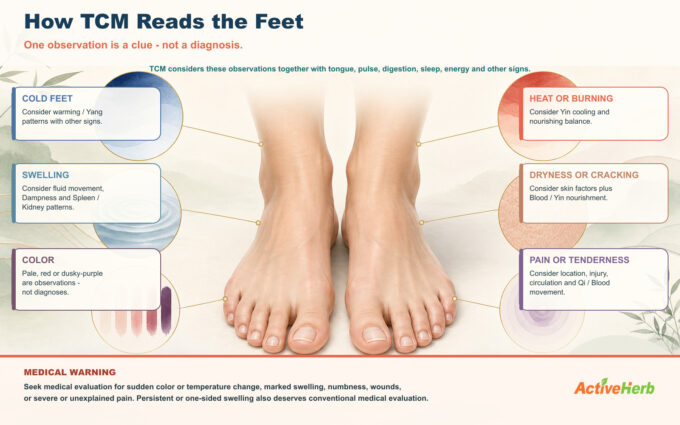
A TCM practitioner isn’t necessarily staring at the arch of your foot and declaring:
“Ah-ha! Your liver is inflamed!”
Instead, the feet may provide one more source of information when identifying a larger pattern.
TCM diagnosis traditionally considers multiple clues together, including:
- Tongue appearance
- Pulse quality
- Skin tone and complexion
- Temperature
- Sweating
- Digestion
- Sleep
- Energy levels
- Pain
- Emotional tendencies
- Menstrual patterns
- Urination and bowel habits
The feet may contribute clues involving temperature, color, sensation, swelling, dryness, circulation, and pain.
In other words, nobody should diagnose your entire constitution because your heel looks cracked and cranky; TCM is more interested in the complete picture.
Cold Feet: Is Your Yang Running Low?
Yes, sometimes cold feet are simply cold feet. You walked outside without socks in winter.
Mystery solved.
But persistently cold feet can carry more significance within TCM pattern theory.
Yang represents the body’s warming and activating qualities.
When Yang is deficient, especially Kidney Yang, a person may experience pronounced coldness in the extremities along with symptoms such as:
- Low energy
- Cold hands and feet
- Lower-back weakness
- Frequent urination
- Loose stools
- Reduced vitality
- A strong preference for warmth
Imagine your body as a house with central heating.
The furnace still works.
It just doesn’t seem powerful enough to get warm air all the way to the rooms at the far end of the building.
Your hands and feet are those rooms.
Hot or Burning Feet: Too Little Yin?
The opposite sensation tells a different story.
In TCM, Yin deficiency may create what is known as deficiency heat or empty heat.
The person doesn’t necessarily have too much heat-producing Yang.
Instead, there may not be enough cooling and nourishing Yin to keep Yang balanced.
One classic symptom is warmth or heat in the palms and soles, sometimes accompanied by:
- Night sweats
- Dry mouth or throat
- Restlessness
- Trouble sleeping
- Afternoon or evening heat
- Dryness
Think of Yin as coolant in a car engine. The engine isn’t necessarily running faster; there simply isn’t enough coolant keeping the temperature under control.
Swollen Feet: When Fluids Aren’t Moving Properly
TCM also pays close attention to fluid metabolism.
The Spleen and Kidney systems play important roles in the transformation, transportation, and regulation of fluids.
When those functions become weakened according to TCM theory, fluid can accumulate rather than moving efficiently.
The result may be sensations of heaviness, puffiness, or swelling.
A TCM practitioner might therefore look beyond the feet and ask questions such as:
Are you frequently tired? Do you feel heavy after meals? Are your stools loose? Do you feel cold? Are you urinating normally?
The answers help distinguish among patterns such as Spleen Qi deficiency, Kidney Yang deficiency, Dampness, or other forms of fluid imbalance.
Foot or ankle swelling can also have conventional medical causes, including some that require prompt attention. Persistent or unexplained swelling should be medically evaluated rather than attributed automatically to a TCM pattern.
Dry or Cracked Feet: Is Nourishment Falling Short?
Dry feet might mean nothing more mysterious than, “Hey bro, have you ever heard of moisturizer. Perhaps you should use it.”
But dryness carries additional meaning within TCM.
Blood and Yin both perform nourishing and moistening roles.
When Blood is deficient, TCM may associate the pattern with symptoms such as:
- Dry skin
- Brittle nails
- Dizziness
- Pale complexion
- Poor sleep
- Dry hair
Yin deficiency can also produce dryness, particularly when accompanied by sensations of heat.
This is why one isolated clue rarely tells the whole story.
Cracked heels alone don’t equal Yin deficiency any more than one cloudy afternoon proves climate change.
Pale, Red, or Purplish Feet: TCM Pays Attention to Color
TCM diagnosis traditionally places considerable emphasis on color.
Paleness may suggest weakness involving Qi or Blood.
Pronounced redness may point toward Heat.
A darker, purplish, or dusky appearance may traditionally be interpreted through the lens of Blood stagnation, meaning Blood is not moving smoothly according to TCM theory.
This same attention to color is one reason the tongue plays such a prominent diagnostic role.
But visible color changes in the feet can also reflect circulation problems, vascular disease, infection, injury, or other medical issues.
If one foot suddenly changes color, becomes cold, painful, markedly swollen, or numb, don’t break out a reflexology chart. Instead, seek appropriate medical evaluation as soon as possible.
Foot Pain and Tenderness In TCM
A reflexologist may apply pressure around the foot and pay attention to areas that feel unusually tender.
Within reflexology theory, tenderness in a particular reflex zone may suggest that the corresponding area of the body could benefit from attention.
A tender stomach zone?
A reflexologist may focus there.
Sensitive kidney area?
That region may receive additional pressure.
But this should not be confused with a validated diagnostic test.
There’s no established biomedical evidence showing that tenderness in a designated patch of the foot reliably diagnoses disease in the corresponding internal organ.
Research on reflexology itself is mixed. Some studies and reviews have reported possible improvements in outcomes such as relaxation, anxiety, fatigue, sleep, or pain in certain populations, while systematic reviews have also found the evidence inconsistent and many studies methodologically weak. This fact shouldn’t detract from a blissful foot massage. It just means your sore “liver reflex” should not replace liver function tests or make you paranoid that you have a chronic health condition.
Beyond Reflexology: TCM Acupressure Points on the Feet
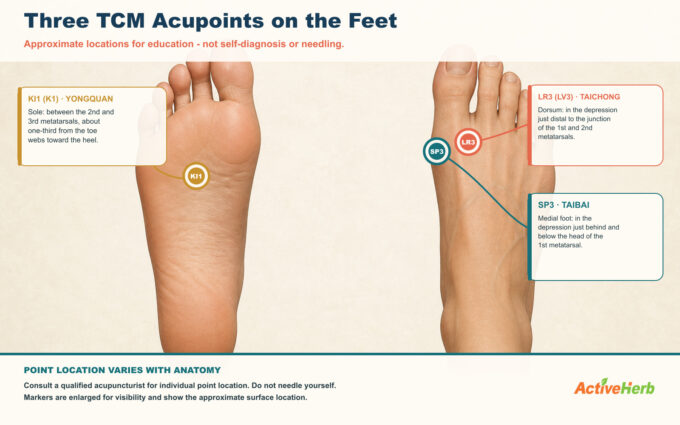
Where reflexology maps broad zones, acupuncture and acupressure target specific acupoints located along meridians.
Several particularly important TCM points are located on or near the feet.
Kidney 1 — Yongquan
Located on the sole of the foot, Kidney 1 is traditionally called Yongquan, or “Gushing Spring.”
It is the first point on the Kidney meridian and is unusual because it sits directly on the sole.
K1 is associated with grounding and helping redirect excessive upward activity downward.
Liver 3 — Taichong
Located on top of the foot between the first and second metatarsal bones, Liver 3 is one of the most frequently used acupuncture points for promoting smooth movement of Liver Qi.
That makes it especially relevant when TCM identifies patterns associated with constraint, tension, or irritability.
Spleen 3 — Taibai
Located along the inner side of the foot near the base of the big toe, Spleen 3 strengthens the Spleen system.
Because the Spleen governs transformation and transportation of food and fluids in TCM, this point appears in treatments involving digestive weakness and certain Dampness patterns.
The important takeaway is that TCM acupressure maps and reflexology maps are not interchangeable.
A reflexologist may work with a broad digestive “zone” on the arch, while an acupuncturist may select a specific Spleen or Stomach meridian point based on the patient’s complete pattern.
It’s like two similar neighborhoods discovered with different GPS systems.
What Your Feet May Be Trying to Tell You
Swelling, wounds, skin changes, temperature differences, numbness, nail abnormalities, and altered circulation can all provide meaningful clinical information.
TCM interprets some of those observations through Qi, Blood, Yin, Yang, Dampness, Heat, Cold, and the functional organ systems, whereas reflexology adds another layer by treating the foot as a miniature map of the body.
That particular mapping system hasn’t been scientifically validated as a diagnostic tool, but reflexology continues to be studied as a complementary practice, particularly for outcomes such as relaxation, pain, fatigue, anxiety, and sleep.
Perhaps the larger lesson is that in TCM, the body leaves clues. Sometimes they’re on your tongue. Other times they’re in your fingernails. And sometimes they’re in your ears. Health clues can also be hiding inside your shoes.
Prefer Your TCM Without Handling Feet?
If the thought of stinky, sweaty feet triggers not your reflex zone but your gag reflex, fortunately, foot reflexology is not the only way to incorporate TCM principles into your wellness routine.
ActiveHerb offers concentrated single-herb extract granules along with traditional Chinese herbal formulas centered around specific TCM patterns and organ systems. So if your preferred interaction with feet is simply putting them up while enjoying a cup of Chinese herbs, we completely understand.
Your toes won’t take it personally.
Related Posts



About The Author
