



TCM for PTSD: Ancient Insights And Modern Applications
The battlefield is silent now, but the horrors remain vivid in the mind of Han Wei, a soldier in the tumultuous Warring States Period of ancient China. His body bears the scars of countless battles, but it’s the invisible wounds that haunt him. One particularly brutal campaign left him trapped under the body of a fallen comrade, surrounded by the screams of dying men and the acrid scent of burning fields. When he finally returned home to his village, the seasonal firecrackers that once symbolized celebration now sent him into a spiral of anxiety and despair. Han Wei couldn’t sleep, felt constantly on edge, and withdrew from his family.
Today, we would recognize Han Wei’s experience as post-traumatic stress disorder (PTSD). Although the term and diagnosis did not exist in ancient China, the effects of emotional trauma were undoubtedly present. The healing traditions of TCM provided tools to address the mental and emotional imbalances soldiers like Han Wei might have endured—and modern research supports their ancient uses.
Acupuncture and PTSD
Post-traumatic stress disorder (PTSD) affects an estimated 6% of U.S. adults and up to 30% of combat veterans, according to the Veteran Administration (VA)’s National Center for PTSD. The VA typically employs a combination of psychotherapy, such as cognitive behavioral therapy (CBT), and medications to manage symptoms. While these methods provide relief for many, they are not universally effective, according to 2018 research published in the journal Frontiers in Behavioral Neuroscience.
Could TCM, a system that’s at least 3,000 years old, offer a viable alternative?
A recent clinical trial published in JAMA Psychiatry, summarized by the Brain & Behavior Research Foundation, suggests that at least one ancient practice—acupuncture—may hold significant promise for managing PTSD.
A groundbreaking clinical trial led by Dr. Michael Hollifield at the Long Beach VA Medical Center explored the effectiveness of acupuncture in treating combat-related PTSD. The study employed a robust design to evaluate the outcomes of 93 veterans over a 15-week period. Participants received 24 sessions of either active acupuncture or sham acupuncture, a method designed to mimic the treatment while avoiding therapeutic points.
Key Findings:
- Statistically Significant Results: Active acupuncture reduced PTSD symptom severity scores from an average of 36 to 18.6. Sham acupuncture also produced some benefit (a reduction to 26.7) due to the placebo effect, but the active group saw significantly more significant improvements.
- Biological Insights: The trial measured the participants’ fear-potentiated startle response and found that active acupuncture enhanced the extinction of learned fear. This suggests acupuncture may influence neural pathways related to trauma and fear processing.
- Retention and Safety: With only 8% of participants dropping out, the study demonstrated high tolerability. Adverse events were minimal and none were serious.
While the study’s results are promising, they are not definitive. Future trials comparing acupuncture to CBT and drug therapies are needed to confirm its role in PTSD treatment.
How TCM Views PTSD: The Shen and Emotional Balance
In TCM, PTSD aligns with the concept of Shen disturbance. The Shen, housed in the Heart, governs consciousness, emotions, and mental clarity. Trauma can scatter the Shen, leading to symptoms like insomnia, hypervigilance, and emotional dysregulation—hallmarks of PTSD. Other organ systems also play a role:
- Liver: Associated with anger and Qi stagnation, the Liver’s imbalance can exacerbate irritability and mood swings.
- Kidneys: Trauma depletes Kidney Jing (essence), leading to fatigue and a sense of fear or insecurity.
- Spleen: Worry and overthinking weaken the Spleen, contributing to digestive issues and lack of focus.
TCM addresses these imbalances holistically, aiming to restore harmony to the mind and body.
TCM Herbal Formulas for Mental Harmony
For those seeking mental balance, TCM offers targeted herbal formulas, including:
Chai Hu Long Gu Mu Li Pian (Bupleurum, Dragon Bone, and Oyster Shell Tablets)
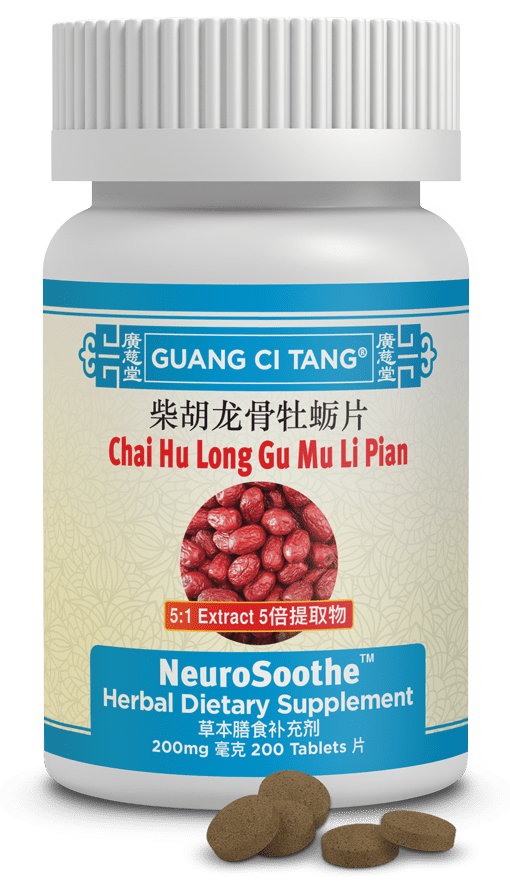
The basis for this formula is the ancient prescription Chai Hu Jia Long Gu Mu Li Tang, originally recorded in the classical text Shang Han Lun (Treatise on Cold Damage). The formula addresses conditions involving emotional disturbances, stress, and nervous system imbalance. Specifically, the formula tackles Liver Qi stagnation with Phlegm accumulation. This imbalance can manifest as anxiousness, irritability, and restlesslessness. By harmonizing Qi, anchoring the Shen, and clearing excess, the formula restores balance and emotional calm.
Available as NeuroSoothe through ActiveHerb’s Guang Ci Tang brand.
An Shen Bu Xin Pian (Calm Shen Tablets)
This formula nourishes the Heart and Kidneys to calm the Shen. It’s particularly suited for individuals experiencing insomnia, anxiety, and palpitations. ActiveHerb offers this time-tested traditional formula as SpiritCalm.
Bu Nao Yang Shen Pian (BrainNew Tablets)
Supporting the Heart and Spleen, this formula, a.k.a. BrainNew, supports memory, focus, and emotional resilience.
Emerging Research on Chinese Herbs and PTSD
Preliminary studies on specific Chinese herbs reveal their potential for supporting mental health, including Suan Zao Ren (Ziziphus Seed), an herb included in BrainNew and supported in a research study published in Current Neuropharmacology. Known for calming the Shen, studies suggest it may offer support during times of occasional anxiousness and sleeplessness. In addition, Huang Qi (Astragalus), which is better known as an immune-support herb, may support mental harmony by strengthening Qi. Research indicates it may regulate stress responses by supporting optimal cortisol levels.
These findings hint at a promising role for Chinese herbs in managing PTSD symptoms, though more research is needed.
The Future of PTSD Integrative Care
While acupuncture and TCM herbs cannot replace conventional PTSD treatments, they may complement them in a holistic care plan. Imagine a future where a fusion of Western medicine and TCM becomes the norm—addressing both the physiological and energetic aspects of trauma recovery.
Explore the Power of TCM for Mental Balance
ActiveHerb.com offers time-tested formulas to support mental health, emotional well-being and cognitive function. Discover how these ancient remedies can help bring harmony to your modern life.
Related Posts



About The Author
