



Life Stages in TCM: How to Support Healthy Aging & Vitality at Any Age

Are your knees creaking more than a wooden floor in a haunted house? Does a strenuous hike necessitate a recovery of several days on the couch? Has the pep in your step been replaced by a more cautious relationship with stairs?
Well, there’s good news and bad news. Let’s get the bad news out of the way….
According to TCM’s “life-stage model,” women reach their physical peak around age 28 and around age 32 for men. (The XY genotype matures slower than XX in both physicality and emotionality, it seems.)
So if you are currently enjoying your AARP benefits and reaping the benefits of senior discounts, don’t despair because now the good news….
According to TCM, even if you’re long past your physical peak, your best years aren’t necessarily behind you. But before you learn how to age gracefully, let’s review the life stages of classical Chinese medicine.
The TCM Life-Stage Model
In Traditional Chinese Medicine, the body is not viewed as a machine that runs at full speed for a few decades and then crashes like a virus-infected Microsoft Windows OS laptop.
Instead, life unfolds in stages.
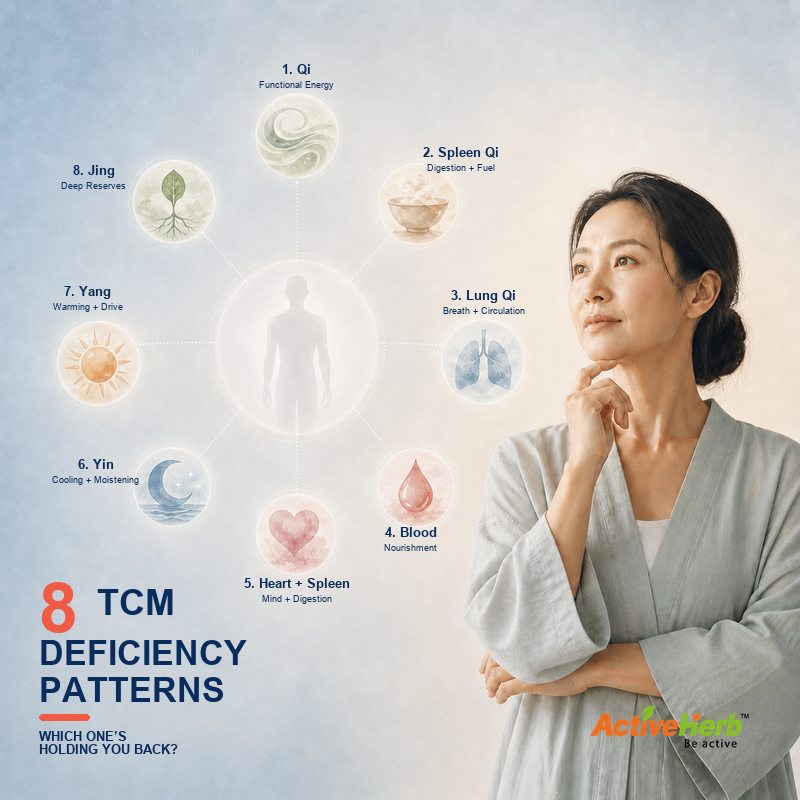
Growth, fertility, strength, digestion, circulation, hair, bones, skin, stamina, and recovery all change over time. These changes are not seen as random. They are part of a larger rhythm shaped by Jing, Qi, Blood, Yin, Yang, and the Kidney system.
This classical view comes from traditional Chinese medical theory, especially the Huangdi Neijing (“Yellow Emperor’s Inner Canon”), one of the foundational texts of Chinese medicine. In that framework, women’s lives are traditionally described in seven-year cycles, while men’s lives are described in eight-year cycles.
These timelines are not rigid biological deadlines. Instead, they’re more like a map. They help explain why certain physical and energetic changes tend to happen around certain ages, and why the body may need different kinds of support as the years go by.
For younger people, the model can be reassuring because it suggests that physical maturity takes time.
For people in midlife and beyond, it may be even more useful because it shows that aging is not simply a story of decline but rather a call to change strategy.
Jing: Your Body’s Vitality Savings Account
If you want to age gracefully using the wisdom of ancient traditional Chinese medicine, get to know Jing.
Think of Jing as the “essence” within your body. One of the body’s deepest reserves, Jing is governed by the Kidney organ system of TCM. TCM’s Kidneys represent a broader functional system connected to growth, reproduction, bones, teeth, hair, development, and aging.
Jing comes in two forms. Prenatal Jing is the essence you inherit from your parents; your deepest constitutional reserve. On the other hand, Postnatal Jing represents the vitality your body continues to build and maintain through lifestyle factors, such as diet, rest, breathing, movement, and digestion.
In other words, your body runs on a savings account and a checking account. Daily energy comes from the checking account: meals, sleep, movement, and recovery. Jing is closer to the savings account. It is precious, and TCM generally advises against raiding it too often.
That is why chronic stress, late nights, extreme dieting, overwork, and excessive exercise are draining in TCM. They may feel manageable in the short term, especially when you are younger. But over time, they can leave the body with less resilience.
This does not mean you need to tiptoe through life wrapped in bubble wrap.
It means that each stage of life has its own best rhythm.
—–> Learn more about Jing on the ActiveHerb.com blog.
Women and the Seven-Year Cycle
In classical TCM, women’s development is traditionally described in seven-year stages.
Around age 7, the Kidney system is growing stronger. Baby teeth fall out, permanent teeth come in, and hair becomes thicker. These are signs that Jing is becoming more abundant.
Then, at around age 14, reproductive development becomes more active. At this stage, the concept of Tian Gui arrives on the developmental scene. Tian Gui is the reproductive essence. The Ren and Chong channels, which are closely associated with menstruation and fertility, become more active. This is the stage when menstruation typically begins.
From there, around age 21, physical growth is considered more complete. The body has matured, and Kidney essence has become steadier.
When women reach approximately 28 years of age, they are at the apex of physical strength. Bones, tendons, muscles, hair, and reproductive vitality are robust at this stage.
Then at around age 35, the first signs of gradual change may begin. Qi and Blood may not rise to the face as abundantly as before. This may manifest as early fine lines, subtle hair changes, menstrual changes, or a metabolism that no longer lets you get away with the same old tricks of junk food bingeing.
Around age 42, the three Yang channels further weaken. The complexion may lose some of its youthful glow, and graying hair may become more noticeable.
Approximately seven years later, at age 49, the classical cycle points to menopause. Tian Gui becomes depleted, and the Ren and Chong channels become less active in their reproductive role.
This major transition implies that the body is no longer directing as much energy toward menstruation and reproduction. Ideally, this stage becomes less about producing and more about preserving, refining, and redirecting vitality.
Men and the Eight-Year Cycle
Men’s development is traditionally described in eight-year stages, but the broad pattern mirrors the women’s seven-year cycle: early Kidney strengthening, reproductive maturity, peak strength, gradual decline, and later-life conservation.
The main difference is timing.
Because the earliest developmental signs are similar, we can skip ahead to age 16, when the male cycle becomes more distinct. This is when Kidney Qi becomes more abundant, reproductive vitality awakens, and reproductive capacity begins to mature.
From there, the male physical peak arrives around age 32, several years after the female peak of around 28. At this stage, vitality, reproductive energy, bone density, muscular development, and physical drive are traditionally considered robust.
The gradual shift begins around age 40, compared with around age 35 for women. Kidney Qi starts to decline, and changes in hair, teeth, stamina, and recovery may become more noticeable.
By around age 48, Yang energy becomes less abundant. Around age 56, the Liver system may weaken, which may be associated with stiffness, dryness, reduced flexibility, or slower recovery.
Then at around age 64, Tian Gui diminishes in men as well. This is roughly the male counterpart to the female transition around age 49.
So while the male cycle follows a similar arc, the build is slower, the peak arrives later, and the shift into conservation is more gradual.
Physical Peak: Not the Same as Lifelong Vitality
The idea of a physical peak can be misleading.
Yes, TCM traditionally associates women’s physical prime with the late twenties and men’s with the early thirties. But peak output is not the only kind of vitality.
A person in their sixties may not recover from a hard workout the way they did at 30. But they may have better self-knowledge, steadier habits, stronger emotional perspective, and a clearer sense of what truly supports their health.
The second half of life is not about pretending the body has not changed. Rather, it’s about working intelligently with those changes.
That means supporting digestion and circulation so Qi and Blood continue to move smoothly. Past physical peak, it’s also paramount to choose movement that builds strength without draining reserves (Yes to Tai Chi, perhaps no to Crossfit.) One at this stage also need to prioritize rest before exhaustion sets in, rather than after the body has already waved several red flags.
After the Peak: What the Body Needs Most
Here, then is a little cheat sheet for aging gracefully if you’re beyond your physical peak:
- Build and preserve Qi.
- Support digestive strength.
- Encourage healthy movement of Blood.
- Protect Jing.
- Avoid extremes that drain the body.
That may not sound as flashy as “biohack your way back to age 25,” but it is a much more realistic and sustainable approach.
TCM Lifestyle Support for Every Stage
ActiveHerb Formulas Traditionally Used for Vitality, Digestion, and Circulation
ActiveHerb offers several formulas that align naturally with life-stages.
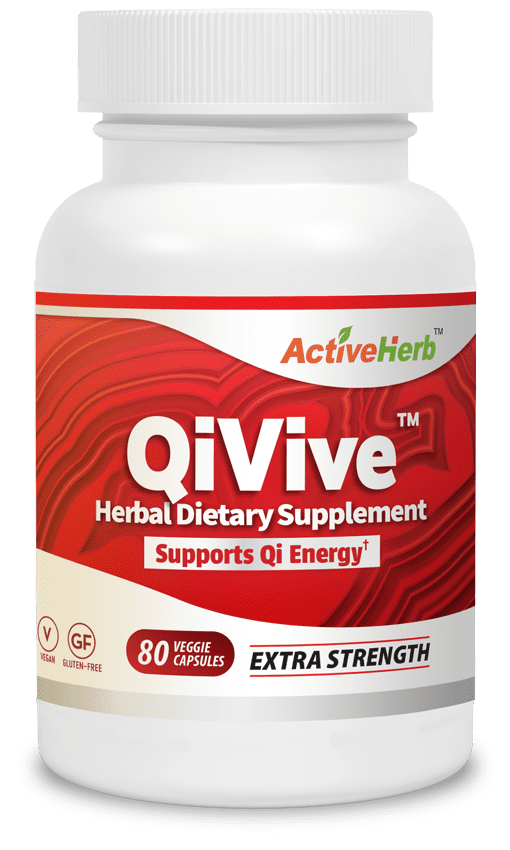
QiVive is designed to support Qi, stamina, and physical vitality. In the context of healthy aging, this may be especially relevant for people who feel that their energy, strength, or resilience is not what it used to be.
In TCM, Qi is closely tied to the body’s ability to move, warm, defend, and sustain activity. Supporting Qi can be especially helpful when the goal is to stay active, maintain physical function, and feel more capable in daily life.
QiVive is a natural fit for the part of the aging conversation focused on staying in physical shape, not by forcing the body harder, but by supporting the energy system that helps the body perform.
DigestVive supports healthy digestion, increasingly important with age because digestion is one of the body’s main sources of vitality. If the Spleen and Stomach are not transforming food efficiently, the body may struggle to create sufficient Qi and Blood.
Preserving vitality is not only about the Kidneys and Jing. It also depends on how well the body can keep producing nourishment day after day.
CircuFine supports healthy circulation and the movement of Blood.
Qi and Blood work together. Qi helps move Blood, while Blood nourishes the body. When circulation is less smooth, the body may feel less flexible, less vibrant, or more prone to stiffness and discomfort.
This makes CircuFine especially relevant for the midlife and later-life discussion. Supporting healthy Blood movement can help the body maintain nourishment, warmth, flexibility, and overall vitality as the years progress.
Together, QiVive, DigestVive, and CircuFine speak to three major pillars of aging well in TCM: energy, digestion, and circulation.
The TCM Life Cycle: Takeaway
Traditional Chinese Medicine views life as a rhythm, not a race.
The seven-year and eight-year cycles remind us that the body has seasons. There are times of growth, abundance, transition, and conservation. Each stage deserves respect.
If you are younger, this model can help you stop rushing the clock.
If you are in midlife, it can help you recognize the body’s changing signals before they become louder.
And if you are in your golden years, TCM offers a hopeful message: vitality is still worth supporting, even after the physical peak years have passed.
You can’t stop time. But thanks to TCM, you can work with it.
Related Posts



About The Author
