



Jie Geng in TCM: We Condone Platycodon For Boosting Vitality and Clearing Stagnation
Suppose you could reach for one herb that overlaps with what people often seek from several different supplement shelves: respiratory support, throat comfort, mucus-clearing, immune support, digestive ease, and even a calmer chest when stress makes breathing feel tight.
At a health store, that might mean something like a lung-support formula, a throat lozenge, an expectorant, an immune-support supplement, and a digestive aid all competing for space in your cabinet.
That is the difference between chasing symptoms one shelf at a time and looking at the pattern underneath them, as Traditional Chinese Medicine (TCM) does. Instead of asking, “What product matches this complaint?” TCM asks, “What is stuck, what needs clearing, and where does the body need movement?”
In Traditional Chinese Medicine, one leading candidate would be Jie Geng, also known as Platycodon root.
Known for opening the chest, clearing phlegm, soothing the throat, and helping Lung Qi move, Jie Geng is far more than a “cough herb.” It is one of TCM’s great multitaskers: a Lung-supporting root that helps open, clear, move, and guide.
What Is Jie Geng?
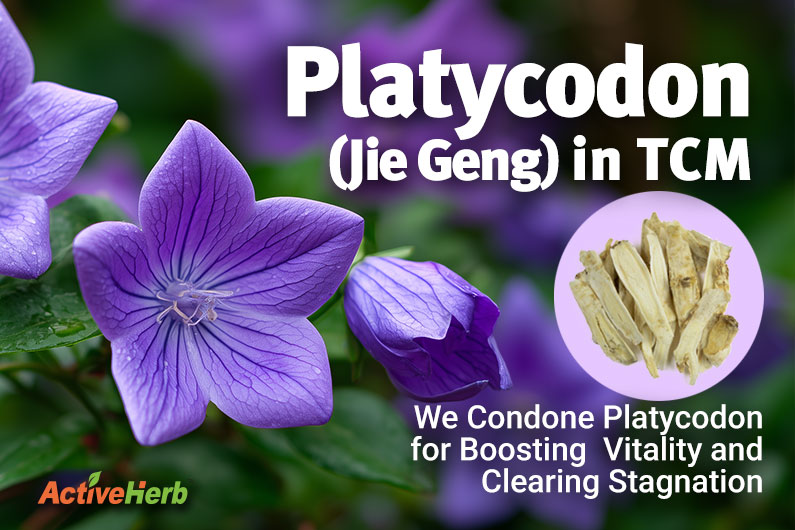
Jie Geng is the dried root of Platycodon grandiflorum, a flowering plant known for its beautiful bell-shaped purple-blue flowers. In China, it is called Jie Geng or Ling Dang Hua. In Korea, it is known as Doraji, where the root is still commonly eaten as a vegetable side dish. (Ancient Far Eastern societies were aware of the “Let food be thy medicine” principle millennia before Hippocrates supposedly uttered that maxim a mere 2400 years ago.)
A 2025 review in Frontiers in Nutrition describes Platycodon grandiflorum as a plant with both medicinal and edible uses. The review notes that its root has long been used in TCM for sore throat, phlegm, pus-draining actions, lung conditions, and respiratory complaints. Modern research has identified several major groups of active compounds, including saponins, flavonoids, polysaccharides, and phenolic acids.
A Root That Looks Like It Wants To Move Energy
At first glance, dried Jie Geng can look a bit like ginseng. It is pale, firm, root-like, and quietly powerful looking.
But in TCM, its personality is different.
Ginseng is famous for strongly tonifying Qi. Jie Geng is more like the traffic officer of the upper body. It helps direct movement. It opens the chest. It supports the Lung system. It helps phlegm move out instead of sitting there like a fog bank over the coastline.
If Qi stagnation feels like Los Angeles rush hour at 5:00 p.m., Jie Geng is the moment the cars suddenly begin moving and the road opens into a peaceful countryside drive. That’s why TCM calls for it when something feels stuck in the chest, throat, or upper body.
Jie Geng and the Lungs
In TCM, the Lungs govern Qi and respiration. They help move and disperse energy throughout the body, especially near the surface. When Lung Qi is constrained, symptoms may show up as coughing, throat discomfort, chest tightness, mucus, or a sense that the upper body just cannot clear itself.
Jie Geng’s traditional uses are as follows:
- Support Lung Qi
- Transform phlegm
- Soothe the throat
- Open the chest
- Help discharge pus in certain traditional pattern contexts
- Guide the actions of other herbs upward
Jie Geng For The Throat
If you have ever had the feeling of a scratchy throat, stuck mucus, or a dry cough that refuses to move along, you can understand why Jie Geng became such an important herb.
TCM often distinguishes between different throat patterns, such as Wind-Cold or Wind-Heat. There’s also dryness, phlegm and constraint.
Jie Geng’s usefulness comes from its ability to resolve stuck conditions. It helps open, disperse, and clear. This is why it appears in many formulas for throat comfort, vocal support, and early-stage external invasions that affect the head and throat.
It is also why the herb makes intuitive sense for singers, speakers, teachers, and anyone whose voice is constantly being asked to perform like a Broadway understudy with no days off.
Platycodon for Phlegm and Stagnation
In TCM, phlegm is not limited to the stuff you cough up.
Phlegm can also describe a broader pattern of accumulation, thickness, cloudiness, or obstruction. It may affect the Lungs, digestion, nodules, skin, or even mental and emotional clarity depending on the pattern.
Jie Geng is classically associated with phlegm in the Lung system. But because TCM views the body as interconnected, phlegm is rarely just a local issue. The Spleen may fail to transform fluids properly. The Lungs may fail to disperse and descend. Qi may become stuck, leading to Dampness.
That is why Jie Geng appears in such a wide range of formulas. It may support respiratory function in one formula, throat comfort in another, digestive transformation in another, and the clearing of phlegm-related accumulations in another.
Jie Geng For Vitality
Jie Geng is not usually categorized as a primary Qi tonic like Ren Shen (ginseng), Huang Qi (astragalus), or Dang Shen (Codonopsis). But that does not mean it has nothing to do with vitality.
Sometimes energy does not need to be “added” so much as it needs to be unstuck.
A person can feel tired because they are depleted (of Qi). But they can also feel tired because Qi is not moving smoothly. They actually may have sufficient Qi, but it’s just not circulating. As a result, the chest can feel tight, or the breath feels shallow. In addition, digestion is sluggish, and mentally, the fog sets in.
Jie Geng helps open the upper body and support the movement of Qi. In that sense, it may contribute to a feeling of greater ease, breath, and vitality when stagnation is part of the picture.
Jie Geng Helps Calm The Spirit
Some traditional descriptions of Jie Geng include references to fear, palpitations, or emotional unease. The 2025 review notes that Shennong Bencao Jing, one of the foundational classics of Chinese herbal medicine, described Platycodon root as slightly warm and pungent and included traditional uses for chest and hypochondriac discomfort, abdominal fullness, intestinal sounds, and palpitations associated with fear.
This does not mean Jie Geng is a stand-alone anxiety herb.
But in TCM, emotions and physiology are inseparable. Fear, constraint, chest tightness, breathing discomfort, and Qi stagnation can all influence each other. When Qi moves more freely, the Shen may feel less trapped in the turbulence.
When the chest opens, the breath deepens, phlegm clears, and Qi moves, the mind and spirit may feel less boxed in.
Where To Purchase Jie Geng
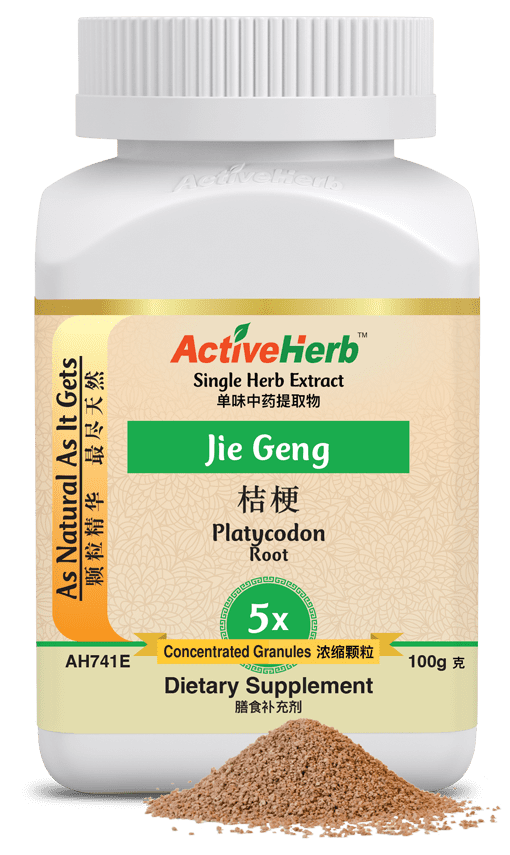
ActiveHerb.com offers single herb extract granules that can be added to warm/hot water for instant tea. If you enjoy decocting herbs the traditional way, you can also purchase Platycodon root raw.
Because Jie Geng can open, clear, move, and guide, it’s featured in several ActiveHerb.com formulas:
HeartVigor – Replenishes the Blood and Yin, and calms the mind.
LungVigor – Nourishes lung Yin energy and moistens the lungs.
Physiclear – Clears heat to support the body’s defensive Qi (immune system)
CF Signoff – Best for the beginning symptoms affecting the throat and head due to a Cold Wind invasion.
Blood Stasisclear – Invigorates Blood removes Blood stasis.
VoiceGold – Supports the vocal cords and comforts the throat.
DigestVive – Support digestive function by nourishing the Spleen and removing Dampness.
NoduleClear – Supports healthy cell division and growth by dispelling Phlegm.
Breathmooth – Supports breathing in cases of Wind-Cold invasion.
Bruise Mender – Supports bones and tendons by promoting blood circulation and removing Blood stasis.
Weitaless – Purges Wind Heat and Dampness that may hinder weight control efforts.
Stomacare – Supports the gastrointestinal environment by resolving Dampness.
CoptisClear – Supports the body’s detoxification processes.
Reference:
Liu W, Jia S, Ma X, Lu D, Du Y, Zhou Z, Yuan L, Yu R, and Nan Y. (2025). Platycodon grandiflorum, as a medicinal and food homologous plant: A comprehensive review of anti-tumor components, mechanisms, modern applications, and preventive healthcare. Frontiers in Nutrition.
Related Posts


About The Author
