


TCM vs. Western Medicine: Which One Comes Out On Top for Sports Injuries?
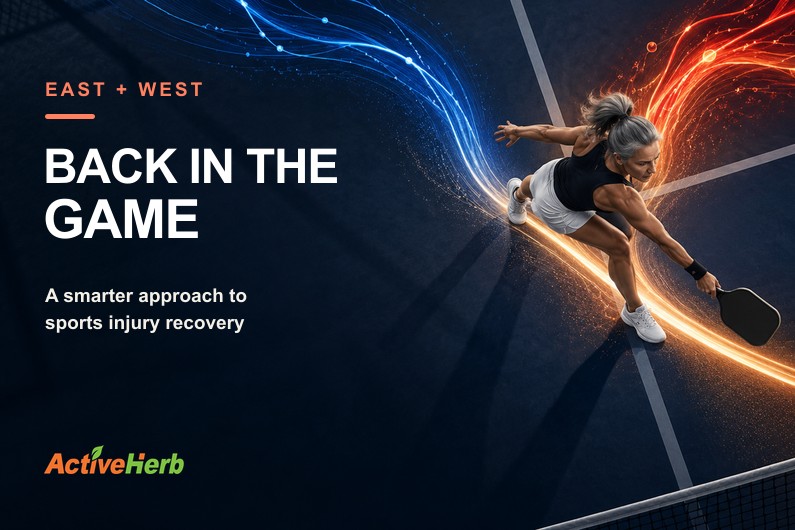
The pickleball bandwagon keeps rolling. And as it does, more and more injuries are being reported.
A study using U.S. emergency department data estimated that pickleball-related injuries jumped from roughly 1,300 in 2014 to more than 24,000 in 2023.
It’s not hard to imagine why. You’re shuffling laterally toward the kitchen line, your opponent drops a shot just out of reach, and you plant your foot, twist and lunge. Suddenly, that friendly Tuesday morning match has produced a barking knee or rolled ankle.
So what gets you back on the court ASAP?
Should a pickleball aficionado (or runner, cyclist, golfer or weekend warrior) try Traditional Chinese Medicine (TCM)? Or are physical therapy, NSAIDs and other Western treatments the faster ticket back into action?
Before we declare a winner, let’s see what each side brings to the court.
How TCM Supports Sports Injury Recovery
Sports injuries frequently involve stagnation, which is the impaired movement of Qi, Blood or fluids through an injured area.
Qi Stagnation describes disrupted energy flow and can lead to tightness, aching or restricted movement. When stagnation persists or trauma significantly impairs circulation, it may progress to Blood Stasis. Blood is no longer circulating smoothly, often producing sharper, more localized pain, swelling, bruising or discoloration.
The goal of TCM for sports injuries is restoring normal movement and circulation while addressing the specific tissues and TCM pattern involved.
Of course, needles are one of the most important tools in the kit for doing just that…
Acupuncture
Acupuncture uses thin needles at specific points to encourage the movement of Qi and Blood through affected channels. For sports injuries, practitioners may select points around the injured area as well as points elsewhere along the associated meridian.
Modern research has also examined acupuncture and related needle techniques for musculoskeletal pain in athletes. A 2026 systematic review and meta-analysis of eight studies published in Frontiers in Medicine found that needling techniques used alone significantly reduced average pain scores. The strongest consistency was seen for shoulder pain in overhead athletes and delayed-onset muscle soreness.
Cupping
Cupping therapy creates suction against the skin. The therapy traditionally helps move stagnant Qi and Blood and is frequently used over large muscular areas such as the back, shoulders and thighs.
Tui Na
Tui Na is a form of Chinese therapeutic massage involving techniques such as kneading, rolling, pressing and stretching. It may be incorporated into treatment when muscle or joint restriction is part of the picture.
Gua Sha
Gua Sha involves repeatedly stroking lubricated skin with a smooth-edged tool. Like cupping, its traditional purpose includes encouraging circulation through areas where Qi and Blood have become stagnant.
How Do Chinese Herbs Help With Sports Injuries?
Chinese herbal medicine doesn’t view every sore knee or pulled muscle as the same problem.
An acute injury involving swelling, tenderness or bruising may suggest Blood Stasis, while chronic joint problems may also involve Wind, Cold or Dampness obstructing the channels. Longer-lasting weakness can introduce yet another consideration: whether Qi, Blood, the Liver or Kidney systems need additional support.
That’s why many injury formulas contain herbs that perform complementary jobs:

Ru Xiang, or frankincense, invigorates Blood and promotes Qi movement. Its Biblical counterpart, Mo Yao, or myrrh, is traditionally paired with Ru Xiang to move Blood and address Stasis. Chuan Xiong (Lovage Root) also invigorates Blood while promoting Qi circulation. San Qi (Notoginseng) is another famous trauma herb associated with stopping bleeding while dispersing Blood Stasis.
ActiveHerb offers several formulas that offer support toward different joints and areas of the body:
| Product | Traditional Use |
|---|---|
| Bruise Mender™ (Jin Gu Die Da Pian) | This extensive formula is specifically formulated to invigorate Blood, dispel Blood Stasis, and support bones and tendons after injuries. |
| JointsJoy™ (Du Huo Ji Sheng Pian) | Nourishes Blood, soothes the sinews, dispels Wind and Dampness, and supports joint and back health. |
| EzJoint™ (Feng Shi Xiao Tong Pian) | Supports joint mobility when Wind-Cold-Damp obstruction and Blood Stagnation are part of the pattern. |
| KneeKinder™ (Xi Guan Jie Tong Pian) | Supports knee function while tonifying Qi and Blood and dispelling Wind, Cold and Dampness. |
| Sciaticlear™ (Zuo Gu Shen Jing Tong Pian) | Formulated specifically to support healthy sciatic nerve function. |
| ShoulderEZ™ (Jian Zhou Tong Pian) | Supports the muscles and tendons surrounding the shoulder. |
| Jing Zhui Tong Pian | Supports the muscles and tendons surrounding the neck and healthy range of motion. |
How the West Gets Athletes Back in the Game
Western sports medicine starts from a very different framework. Rather than diagnosing Qi Stagnation or Blood Stasis, a physician or physical therapist wants to know which structure was injured and how badly.
Physical therapy, ice, compression and activity modification help recovery from acute injury. Imaging such as X-rays or MRI can identify fractures, ligament tears and other structural damage that acupuncture needles obviously can’t diagnose.
Then there are medications such as non-steroidal anti-inflammatory drugs (NSAIDS), such as ibuprofen and naproxen. They can be very effective for short-term symptom relief, but they aren’t harmless simply because some are sold over the counter. They may cause gastrointestinal and kidney complications. And abuse of NSAIDs can cause liver injury. People using them frequently or who already have concerns about liver health should discuss medication use with their healthcare provider.
For serious injuries—a torn ACL, displaced fracture or ruptured tendon, for example—Western diagnostics, orthopedic care and sometimes surgery are indispensable.
East vs. West: Who Wins the Sports Injury Showdown?
Maybe nobody has to lose.
A torn ligament doesn’t stop being torn because you receive acupuncture. Likewise, identifying an injured structure on an MRI doesn’t automatically restore circulation, mobility or relieve every lingering ache.
That’s where integrative treatment may be the winner.
A 2026 systematic review and meta-analysis found that needle-based acupuncture techniques may help reduce athletic musculoskeletal pain, particularly when combined with physical therapy or exercise.
Researchers are also testing the integrative approach directly. A 2025 randomized clinical trial protocol involving 174 patients with post-acute ankle sprains compares routine treatment with a rehabilitation program that combines Traditional Chinese and Western medicine.
In other words, this doesn’t have to be acupuncture versus physical therapy, Chinese herbs versus an orthopedist, or East versus West.
Western medicine excels at identifying structural damage, ruling out serious injuries and rebuilding strength and function. TCM offers another set of tools for supporting circulation, easing discomfort and addressing the patterns that may accompany recovery.
If your goal is getting back onto the pickleball court—or surfboard, trail, bike or golf course—the smartest play may be taking useful tools from both sides of the net.
Related Posts



About The Author
